

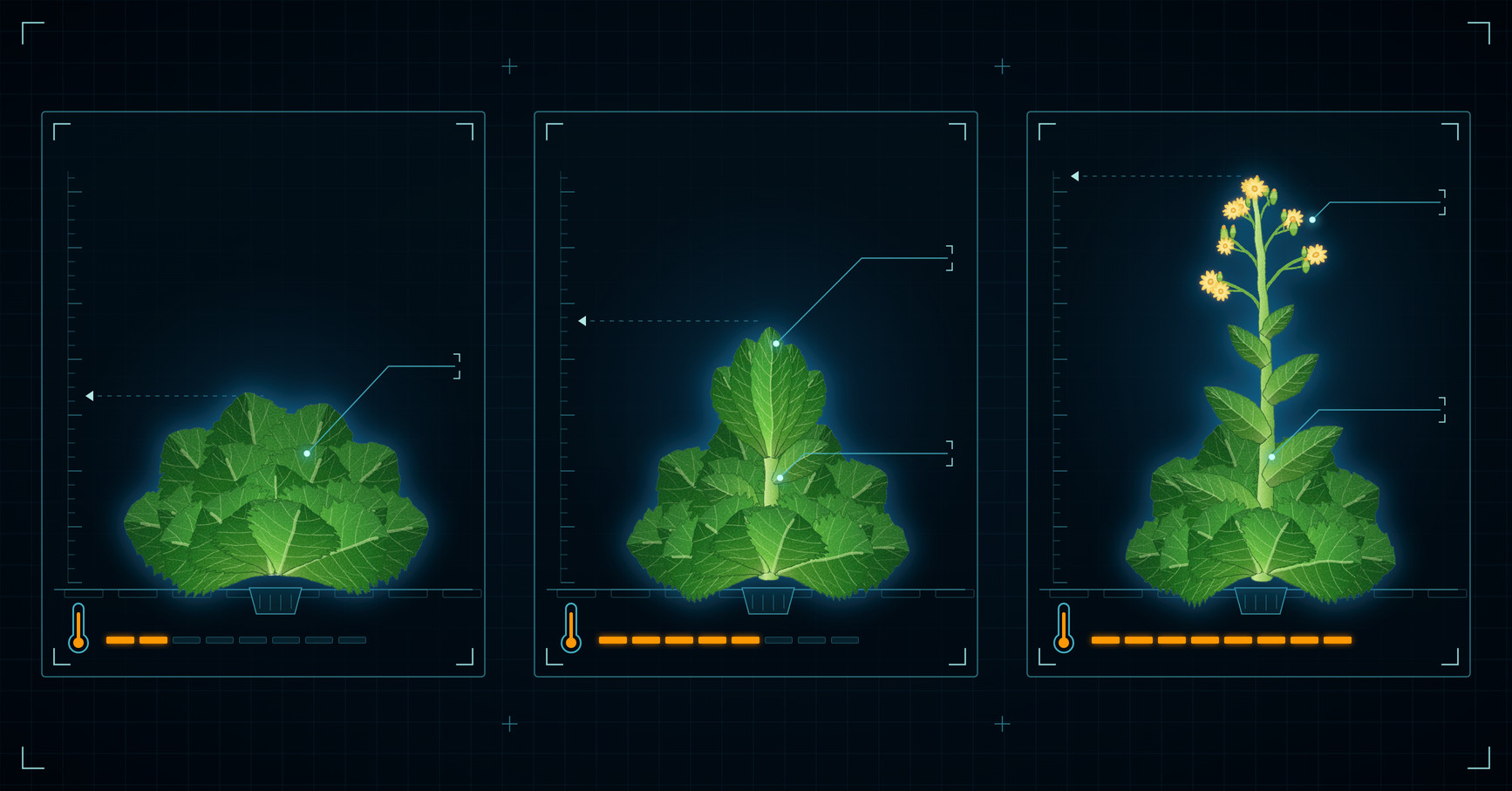
Bolting Isn’t a Variety Problem. It’s a Temperature Exposure Problem.
How to prevent lettuce bolting is the question every leafy greens operator asks once a summer planting goes to seed, and the answer they usually reach for is a bolt-resistant cultivar. It is a reasonable answer. It is also not enough on its own. In one controlled study, a lettuce line selected and described as bolting-resistant went to seed inside eight days under sustained heat. The variety did not fail. It did what every variety does once the environment crosses the threshold, and it bought about a week doing it:
Why does lettuce bolt even with a resistant variety? Because resistance delays the transition, it does not prevent it. A bolting-resistant line held at 33/25°C showed significantly elevated stem elongation by day 8. What should you manage instead? Time above the 16 to 18°C optimum, alongside photoperiod, because the two interact. Bolting is irreversible once the plant commits, so the only lever that works is the one you pull before commitment.
PDS tracks your environmental data against growth stage and light schedule, so the exposure that drives the transition is visible while you can still act on it.
Show me how PDS tracks thisFrom the 8th day of high-temperature treatment, the lettuce stem elongation rate was significantly higher than the stem elongation rate observed for the control group.
Eight days. In the resistant line. That is the number worth sitting with, because it reframes what cultivar selection buys you.
The conventional advice and why it usually fails
When a planting bolts, the playbook is well worn. Switch to a bolt-resistant or slow-bolting cultivar. Move summer production to a cooler part of the year. Pull the harvest window forward and cut smaller heads. Run shade cloth through the middle of the day. Increase misting or evaporative cooling. Drop the night setpoint. Start the next succession earlier.
Where each of these is right. Cultivar selection is a documented lever: supraoptimal air temperature and cultivar interact on yield and morphology in greenhouse green leaf lettuce, and the interaction is large enough that variety choice changes the outcome under the same conditions (Stallknecht 2026). Season and cultivar interact the same way in hydroponic production (Hernandez et al. 2017). Harvesting early is a legitimate salvage move. Shade and cooling reduce exposure, which is the correct target even when the execution is blunt.
Where they fail as a strategy. Every one of these is a response to a planting that is already under pressure, and most are applied after the operator has seen stretch in the canopy. Stretch is the second half of bolting, not the first. The plant initiates floral development at the shoot apical meristem and then elongates the stem, so by the time the crop looks wrong the developmental decision has been taken. Nothing returns a committed plant to vegetative growth. The transition is one-way.
And the cultivar lever has a ceiling that operators consistently over-trust. The Hao study did not run its heat treatment on a susceptible line to prove a point. It ran it on a resistant one, and the resistant one bolted in eight days. A better variety changes how much exposure you can absorb before the switch flips. It does not remove the switch.
What the science says
Bolting is two processes, not one. Floral initiation happens at the shoot apical meristem. Stem internode elongation follows. Operators see the second and manage as though it were the first.
The trigger is temperature, and the thresholds are unusually clean for a physiological disorder. Most lettuce cultivars are productive at 16 to 18°C. Above roughly 24°C, bolting and flowering are promoted. That band is narrow enough that a summer greenhouse can sit above it for most of a working day without anyone treating the room as being in a stress condition.
Underneath the threshold is a signalling cascade that is now well characterised in lettuce specifically. CONSTANS is expressed in the phloem and activates FLOWERING LOCUS T. FT translocates to the apical meristem and activates FUL and SOC1, which in turn activate the floral meristem genes. Heat pushes on this pathway at several points at once. LsMYB15 regulates bolting under high-temperature stress (Chen et al. 2022). LsRGL1 works through the gibberellin pathway (Wang et al. 2022). The LsFUL and LsSMU2 module controls bolting time under high temperature (Zhong et al. 2024). Three separate floral pathways, photoperiod, age and gibberellin, are implicated in heat-induced bolting rather than one.
That last point has a practical consequence. Temperature is the dominant lever but it is not the only input. The major bolting and flowering locus in lettuce, qFLT7.2, has an effect strongly influenced by both photoperiod and temperature (Rosental et al. 2021). An operation running long supplemental photoperiods through a warm cycle is loading two inputs at once, and managing only one of them.
The environmental drivers that matter
Four variables move the outcome. PDS already collects all of them.
- Time spent above the optimum bandNot the peak reading. The duration. Hao’s treatment produced a measurable transition by day 8 of sustained 33/25°C exposure in a resistant line, which means the relevant quantity is how long the crop sits above its comfortable range rather than how high the worst hour went. Two rooms can share a daily maximum and differ enormously in total time above 24°C. It is the kind of total an environmental analyzer should be keeping for you, because nobody computes it by looking at a graph.
- Photoperiod, including your supplemental lightingThe qFLT7.2 effect is influenced by photoperiod and temperature together (Rosental et al. 2021), and the photoperiod pathway is one of three implicated in heat-induced bolting. Lighting schedules set for growth rate are also setting a floral signal. If summer bolting coincides with your longest supplemental days, that is not a coincidence worth ignoring.
- Night temperature as a separate variableDay and night are usually discussed as one setpoint and they are not the same lever. Note the honest limit here: the controlled work moved both together, 33/25°C against 20/13°C, so the night term has not been isolated experimentally. What can be said is that a room failing to shed heat overnight is accumulating exposure through hours nobody is watching.
- Cycle stage when the exposure landsBolting is a developmental transition, so the same heat does not carry the same risk at every point in the crop. Exposure late in a cycle that is already approaching harvest is a different proposition from the same exposure on a young planting with weeks to run. Pairing environmental history with planting and harvest scheduling is what turns a temperature log into a decision.
How bolting shows up across crops
Lettuce. The best-characterised case and the one the mechanism work is built on. The failure is economically brutal because it is synchronised: a planting shares an environment, so when the threshold is crossed it is crossed for the whole block rather than for scattered plants. Bitterness and a lengthening stem make heads unsaleable, and there is no downgrade market for a bolted head the way there is for a small one.
Cilantro. Faster and less forgiving than lettuce, and the literature is thinner. What exists is agronomic rather than environmental. Growth regulators reduced preharvest bolting in open-field cilantro cv. Santo (Meyering et al. 2020), and cultivar and row spacing affect yield across fall and spring production (Berkomah et al. 2022). Both are field studies. No controlled-environment study of cilantro bolting under managed temperature was located, so the honest position is that the lettuce mechanism is the best available guide and the crop-specific thresholds have not been published. Treat cilantro as the earlier warning in a mixed leafy programme rather than as a crop with its own validated numbers.
Arugula, spinach and basil. All make the same reproductive transition under heat and long days, with different tolerances and different commercial consequences. Basil flowering changes leaf quality rather than ending saleability outright, which makes it the crop where the transition is most often absorbed rather than noticed.
Dense multi-crop leafy programmes. Operations running several leafy species through shared rooms face a scheduling problem more than a physiological one. The species do not share thresholds, so a room held at a compromise setpoint is inevitably above optimum for the most sensitive crop in it. That is a decision worth making deliberately rather than discovering at harvest. The same environmental history that drives tipburn in dense leafy canopies is being logged already.
Variety selection is part of the answer
Cultivar is a lever that works, and the breeding programmes are active. Genetic loci affecting earliness of bolting and flowering have been mapped in lettuce, and breeding for controlled environment production is a live field (Rosental et al. 2021). Supraoptimal temperature and cultivar interact measurably in greenhouse production (Stallknecht 2026). Choosing a slow-bolting line for summer successions is correct and you should do it.
It is also partial, and the Hao result is the cleanest statement of why. The resistant line still bolted in eight days. Under enough exposure every commercial lettuce cultivar makes the transition, because the transition is what the plant is built to do when conditions say the season is ending.
The framing is the same one used in the blossom end rot piece. Variety is part of the answer, not the answer. Pair the most tolerant cultivar your market will take with environmental management that keeps time above optimum inside what that cultivar can absorb. The cultivar decision is yours. The exposure data is something software should be handing you.
Five questions to diagnose your bolting risk
Before the next summer succession goes in, run the operator-grade diagnostic.
- How many hours did last summer’s bolted planting spend above 24°C, in total, across its whole cycle? Not the peak. The total. If you cannot answer that from your own logs, you are selecting cultivars without knowing what you are asking them to absorb.
- What was your supplemental photoperiod through that same window? Photoperiod and temperature interact on the major bolting locus, so a long-day schedule during a warm cycle is two inputs pushing the same direction.
- What is your night temperature doing, separately from your day setpoint? A room that does not shed heat overnight accumulates exposure through hours that rarely appear in a walkthrough.
- At what cycle stage did the exposure land? The same conditions carry different risk on a two-week-old planting than on one approaching harvest, and the response differs accordingly.
- Do you know the difference in time-above-optimum between the room that bolted and the room that did not? If two rooms in the same facility behaved differently, the answer is in that gap, and it is measurable.
Real results, not more dashboards. That is the cultivation intelligence question.
How do you prevent lettuce bolting? Not with a variety alone, and not with a reaction once the canopy stretches. The transition is irreversible, it is driven by exposure to temperature above a narrow optimum, and photoperiod loads the same pathway alongside it. A bolting-resistant cultivar held at 33/25°C still went to seed in eight days, which tells you what resistance buys and what it does not. Preventing lettuce bolting means managing the hours before commitment, on a crop where the loss lands across a whole planting at once and a bad summer succession is the kind of number that decides a season.
Watch the exposure. Keep the crop.
See how PDS connects the environmental data your sensors already produce, alongside light schedules and growth stage, into one cultivation intelligence platform built for operators running leafy greens through the warm end of the year.
Frequently Asked Questions
Why does my lettuce bolt even though I planted a bolt-resistant variety?
Because resistance delays the transition rather than preventing it. In controlled work, a lettuce line described as bolting-resistant showed significantly elevated stem elongation by day 8 under sustained 33/25 degrees Celsius conditions. A slow-bolting cultivar increases how much exposure the crop can absorb before it commits, which is worth having, but every commercial cultivar makes the transition once the threshold is crossed for long enough.
At what temperature does lettuce start to bolt?
Most lettuce cultivars are productive around 16 to 18 degrees Celsius, and temperatures above roughly 24 degrees promote bolting and flowering. The practical problem is that this band is narrow, so a greenhouse can spend most of a working day above it without the room registering as being in a stress condition. What matters is the total time spent above the optimum across the cycle, not the single hottest hour.
Can you reverse bolting once it starts?
No. The reproductive transition is one-way, and no intervention returns a committed plant to vegetative growth. This is the reason reactive management fails. Bolting is two processes, floral initiation at the shoot apical meristem followed by stem elongation, and the visible stretch operators respond to is the second one. By the time the canopy looks wrong the decision has already been taken.
Does lighting affect bolting, or is it only temperature?
Both, and they interact. The major bolting and flowering locus in lettuce has an effect strongly influenced by photoperiod and temperature together, and the photoperiod pathway is one of three implicated in heat-induced bolting alongside age and gibberellin. A long supplemental photoperiod through a warm cycle loads two inputs in the same direction, so a lighting schedule set purely for growth rate is also setting a floral signal.
Is cilantro bolting the same problem as lettuce bolting?
Mechanistically similar, but the evidence base is much thinner and the crop is less forgiving. The published cilantro work is agronomic rather than environmental: growth regulators reduced preharvest bolting in open-field production, and cultivar and row spacing affect yield across seasons. No controlled-environment study of cilantro bolting under managed temperature appears to have been published, so the lettuce mechanism is the best available guide and crop-specific thresholds should be treated as unestablished.
- Hao, J., Su, H., Zhang, L., Liu, C., Han, Y., Qin, X. & Fan, S. (2021). “Quantitative proteomic analyses reveal that energy metabolism and protein biosynthesis reinitiation are responsible for the initiation of bolting induced by high temperature in lettuce (Lactuca sativa L.).” BMC Genomics 22:427. doi.org/10.1186/s12864-021-07664-5
- Stallknecht, E.J. (2026). “Influence of Supraoptimal Air Temperature and Cultivar on Yield, Morphology, and Production Considerations of Green Leaf Lettuce in Greenhouses.” HortTechnology 36(1):75 to 85. doi.org/10.21273/HORTTECH05805-25
- Rosental, L. et al. (2021). “Mapping and Identification of Genetic Loci Affecting Earliness of Bolting and Flowering in Lettuce.” Theoretical and Applied Genetics 134(10):3319 to 3337. doi.org/10.1007/s00122-021-03898-9
- Chen, L. et al. (2022). “LsMYB15 Regulates Bolting in Leaf Lettuce (Lactuca sativa L.) Under High-Temperature Stress.” Frontiers in Plant Science 13:921021. doi.org/10.3389/fpls.2022.921021
- Zhong, M. et al. (2024). “LsFUL-LsSMU2 module positively controls bolting time in leaf lettuce (Lactuca sativa L.) under high temperature.” Plant Science 347:112195. doi.org/10.1016/j.plantsci.2024.112195
- Wang, S. et al. (2022). “LsRGL1 controls the bolting and flowering times of lettuce by modulating the gibberellin pathway.” Plant Science 316:111175. doi.org/10.1016/j.plantsci.2021.111175
- Hernandez, E. et al. (2017). “Evaluation of season, cultivar, and aeration on biomass production of greenhouse hydroponic lettuce.” Acta Horticulturae 1170:619 to 626. doi.org/10.17660/ActaHortic.2017.1170.77
- Meyering, B. et al. (2020). “Reducing Preharvest Bolting in Open-field-grown Cilantro (Coriandrum sativum L. cv. Santo) through Use of Growth Regulators.” HortScience 55(1):63 to 70. doi.org/10.21273/HORTSCI14614-19
- Berkomah, J. et al. (2022). “Cilantro and Coriander Yield as Affected by Cultivars and Row Spacings in Fall and Spring Production in Virginia.” HortScience 57(9):1156 to 1158. doi.org/10.21273/HORTSCI16759-22

Comments are closed